Circle Between Realms
“Circle Between Realms” (2025)
Mixed Media with Video Projection and Sound
15:00 min loop
First exhibited at the Ilham Art Show 2025
“Circle Between Realms” explores the symbolism of communication and transportation between the human and spirit realms, drawn from the rich cultural heritage of the Bidayuh people of Bau district, Sarawak, Malaysia. As a priestess, Dayung Borih serves as a sacred mediator, facilitating the descent of Topa (God) and I’eng (spirits) into the human realm to bless the Gawai ritual. The work highlights the role of the Taya, a spiritual vessel, as a bridge that symbolises the interconnectedness of all beings – a central tenet of Indigenous worldviews.
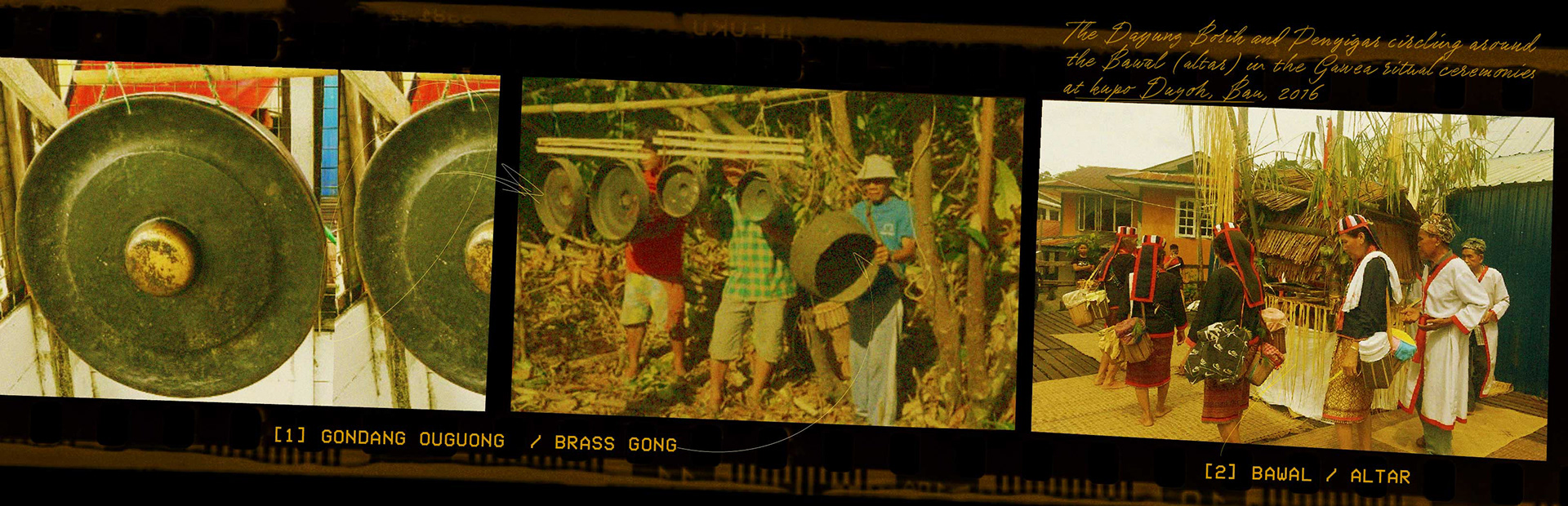
Accompanied by the resonating sound of the Gondang ouguong (brass gong) [1], the ritual of circumambulating the Bawal (altar) by the Pinguguoh (senior priest), Pinyigar (junior priest) and Dayung Borih [2] summons the simonggi i’eng podi (spirits of the paddy). This is mirrored in the installation through the circular arrangement of paddy seeds symbolising the Bawal, ritual altar. Its form creates a sacred boundary for placing offerings, marking the threshold between the human and spirit realms. This configuration not only reinforces the profound bond between humanity and nature but also serves as a reminder of the harmony essential for universal balance, something that is now endangered by modernisation and environmental exploitation.
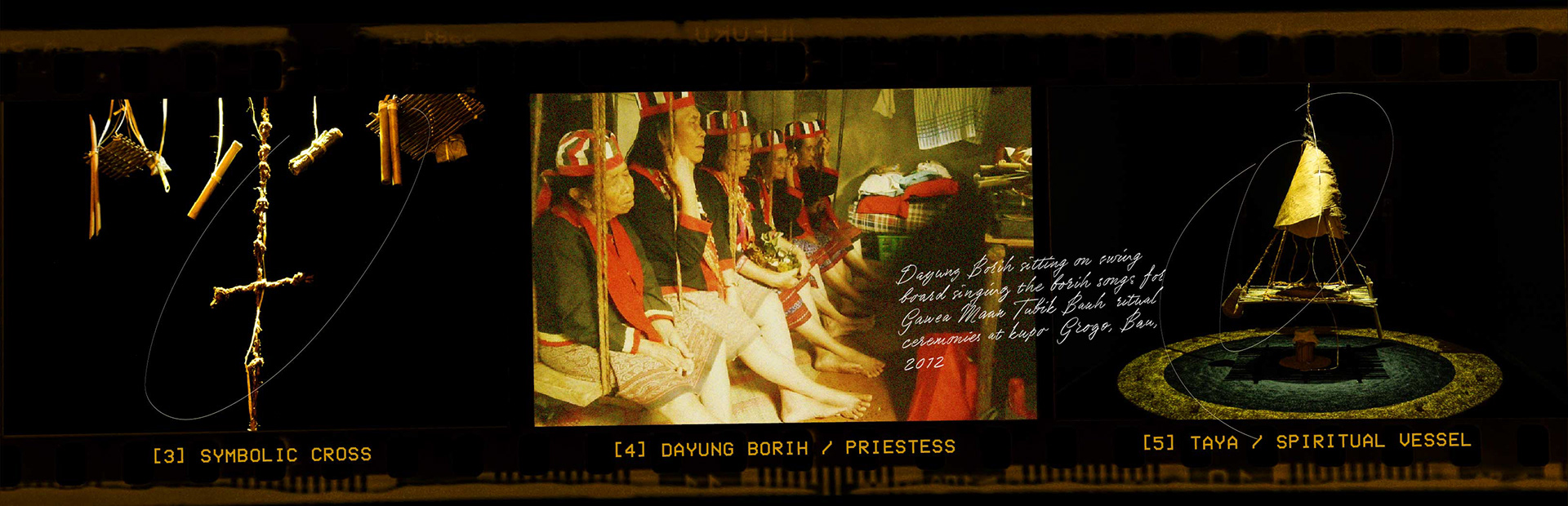
The symbolic layering of the cross [3] within the composition reflects the duality of cultural transformation. Christianity reached Bidayuh communities as early as 1841 during the era of James Brooke, introduced by Roman Catholic and Anglican missionaries. By the late 1960s, Christianity had become widely accepted among the Bidayuh people. However, this spread has also impacted and reshaped their cultural and ritualistic practices.
Within this artwork, the cross becomes a site of tension, a visual negotiation between tradition, religion, and modernity. Its presence alongside ritualistic motifs and ancestral cosmologies highlights the complex interplay between inherited belief systems and newer spiritual influences. This juxtaposition captures the ongoing process of cultural adaptation, where sacred practices, colonial legacies, and contemporary identities converge and coexist.
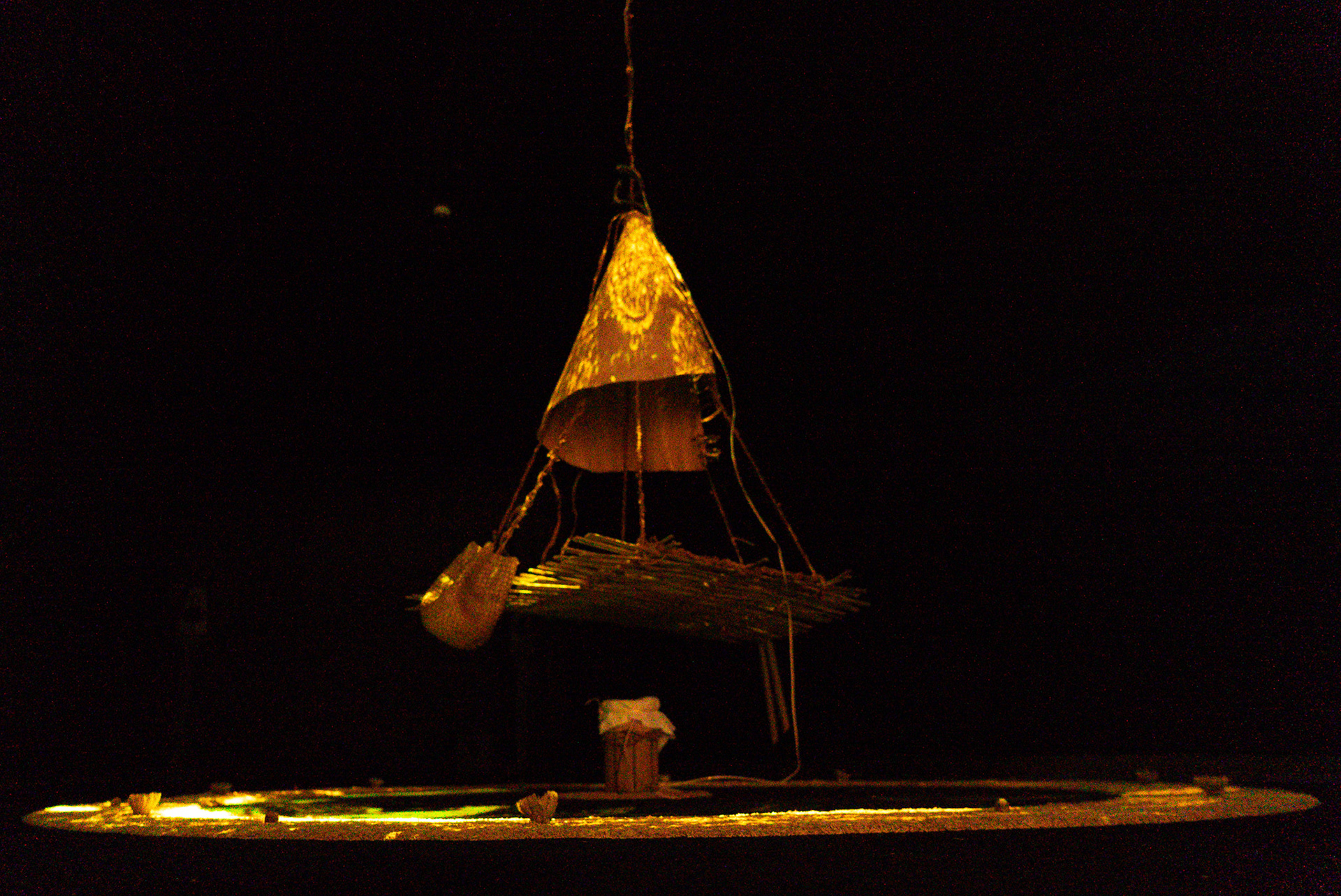
The Dayung Borih [4] perceives time differently on earth and in the spiritual realm, and this work seeks to interpret that experience using video projection and an ethereal soundscape. A video projection is mapped onto the circular arrangement of the paddy seeds surrounding the Taya [5]. This demarcates the threshold between the realms.
According to the myth of the Adat Dayung Borih, the Taya is a transport vessel for the priestess to travel from the spirit world to the human world. The story recounts the tale of Ngomak (Dayung Borih), who fell ill with a spirit-related sickness and was taken to the sky by Sino Bowang for healing. There, she became the first Dayung Borih, learning rituals, chants, and healing practices. Out of love for her grieving husband, Ngomak later descended to earth using the Taya, secretly helping him in the paddy fields. After completing her ritual obligations, she returned to live on earth with spiritual powers and taught other women to become Dayung Borih. This myth explains the origins of the Dayung Borih tradition and the symbolic role of the Taya in Bidayuh rituals.
Though usually no larger than 15–30 cm, the Taya is believed to expand to life-size for the Dayung Borih in the spiritual realm. This installation considers how the Taya might appear at that scale, both as an examination of its form and an interpretation of this belief. At this scale, the intricate details of the Taya come into greater focus.
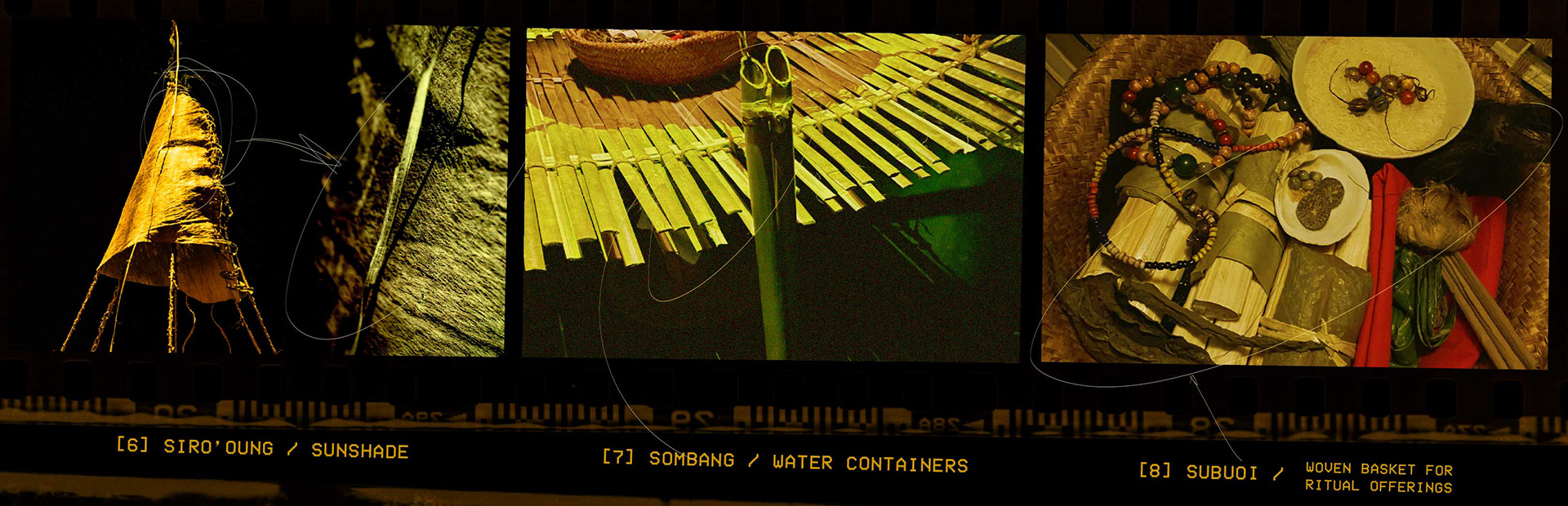
The Taya is made from bamboo, cut and woven into a square, which becomes a seat for the Dayung Borih as she descends onto earth. Pak pogang, a rope traditionally made using the bamboo outer layer (bamboo used to cook glutinous rice), is scraped and tied at each of the four edges. In this version, we utilised the braided tree bark for additional stability. The woven bamboo is used as the base, and four tree bark ropes are tied together, forming a pyramid shape. Typically made with the manah leaf, a tree bark is used instead to be folded into a conical shape for protection from the rain and heat of the sun for the Dayung Borih, called Siro’oung [6]. The Sombang [7], which is made from two bamboo, are tied together with a rope to be used as a water container. It is also accompanied by a Juouh/Onyad, a woven pouch that hangs off the side of the Taya, and is usually filled with travel provisions such as rice, meat, areca nuts and others wrapped with manah leaves. A Subuoi (woven basket) [8] sits in the middle with prosih (beads and bells), white rice, yellow rice, ornamental beads and bells, sukoi/ajang (pogang, manah leaf), betel leaf, areca nuts, nipah leaf cigarettes, tobacco, lime paste, e’juok, buak juli (shelled coix seeds), serving as offerings to the spirits.
The soundscape comprises synthesised audio captured from the last traditional annual Gawai in 2019, including the chanting of the Dayung Borih, the sound of the brass gong and Belalang (ancestral bell), and recordings of the river and the great argus. The animation parallels the journey of the Dayung Borih as it traverses across the realms in three acts. It begins with the invitation to the spirits, followed by the ritual dance offering for the villagers, and concludes with the Dayung Borih's ascension to the spiritual realm.
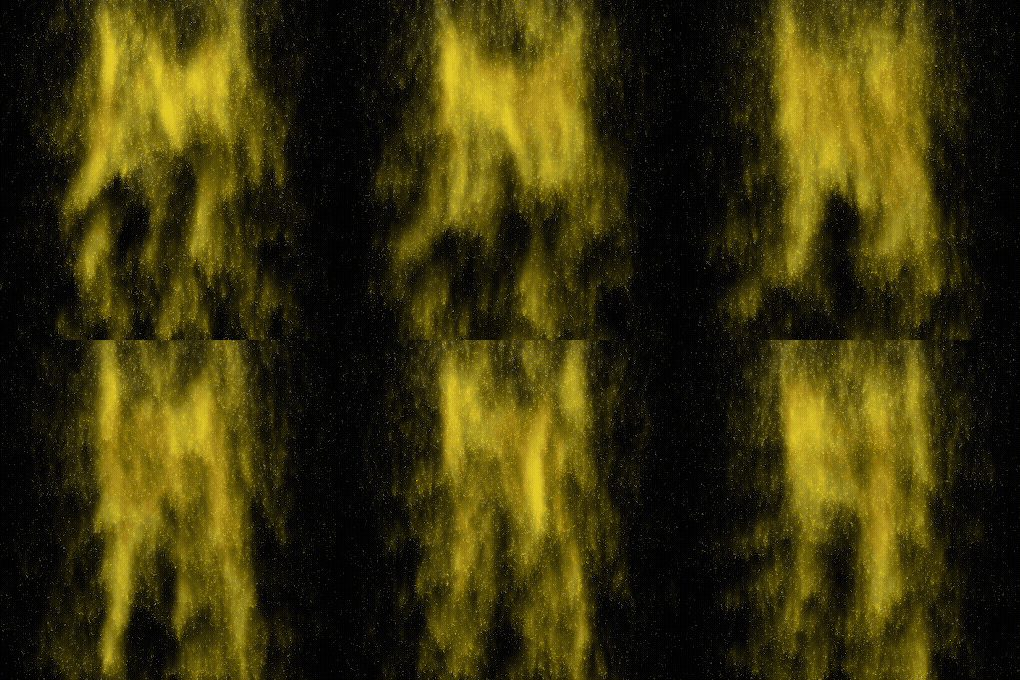
Act 1: Invitation to the Spirits
The animation opens with motifs inspired by the great argus pheasant and the flowing rivers, symbolising the connection between nature, ancestral beings, and the human world. The rhythmic presence of the Rasang (great argus) wood carving recalls its ritual use during Gawea Ngidaan Rasang, where the Dayung Borih invites the spirits through dance. Layered with great argus calls, ancestral Belalang brass bells, borih chants from the 2019 ritual, and the deep resonance of Gondang ouguong (brass gong), this act represents the ceremonial calling of I’eng podi (spirits), a plea for the ancestors to return and bless the community.
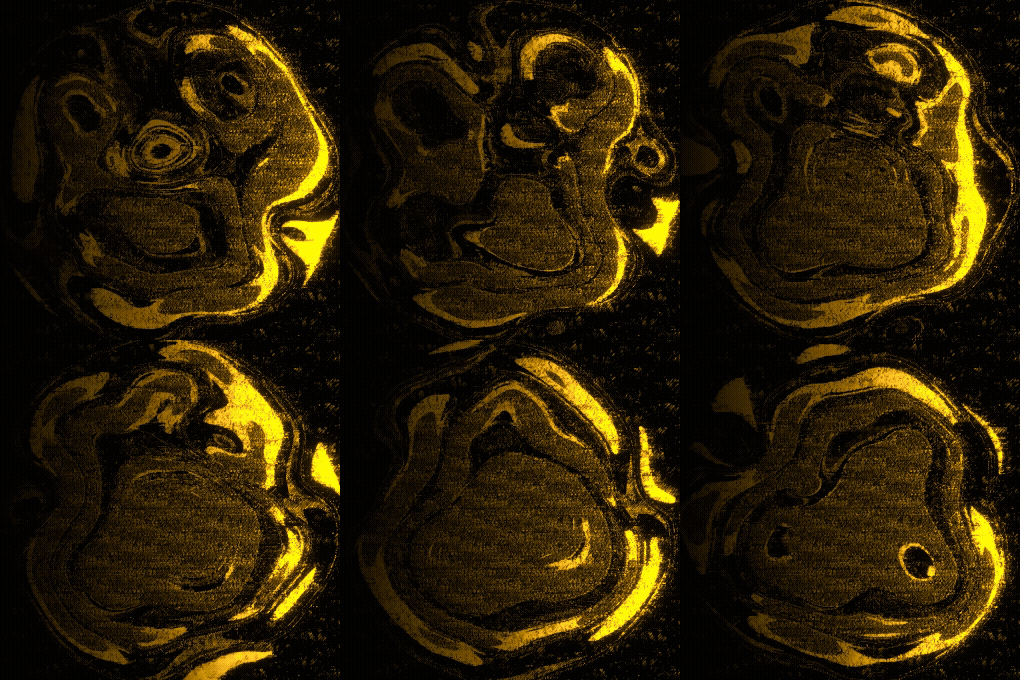
Act 2: Rituals, Offerings and Blessings
The animation transitions into the heart of the ritual, guided by the symbolic patterns of the Sunda Clouded Leopard, as depicted in Bisuwi wood carvings. This act reflects the communal offering and thanksgiving rituals performed by the Dayung Borih, Pinguguoh, and Pinyigar, who circle the Bawal (altar) while chanting and dancing. The repetition of the brass gong rhythms embodies protection, gratitude, and the invocation of blessings for the village and the new agricultural cycle. Here, movement, sound, and carved motifs converge to express continuity, resilience, and spiritual guardianship.
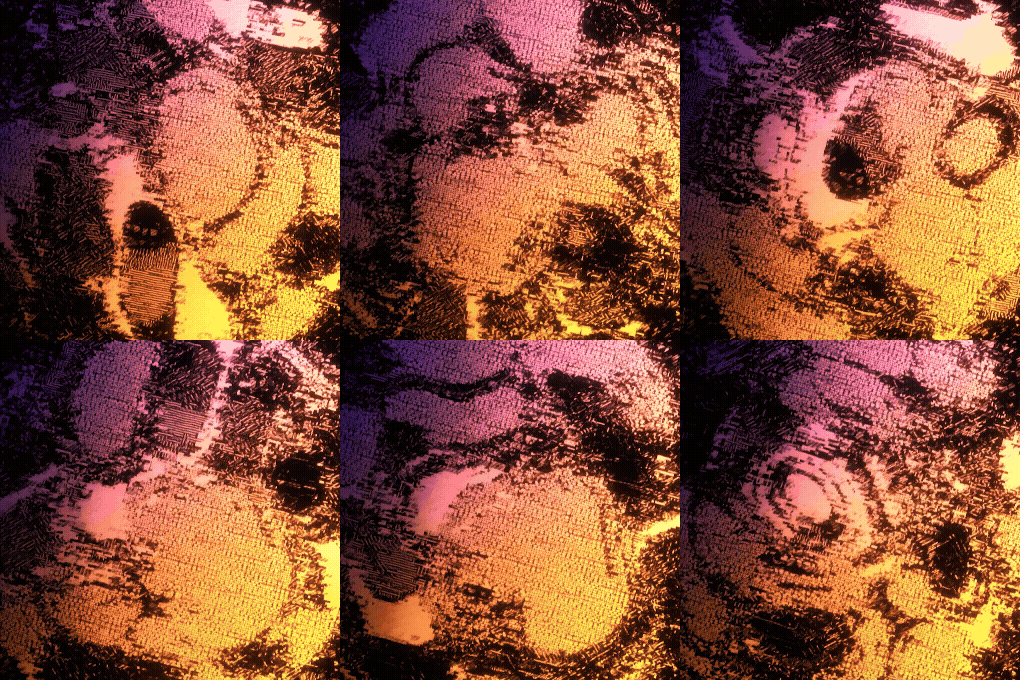
Act 3: Ascension to the Spiritual Realm
The final act centres on the Bornean Peacock-pheasant, symbolising transformation, transcendence, and rare spiritual presence. As the gongs intensify, the Dayung Borih enters a trance state (Gimoro), culminating in the moment of ascension to the spiritual realm during Nyigar Nguguoh. This act visualises the liminal journey between worlds, where the priestess becomes the bridge between the human and ancestral realms. As the soundscape crescendoes, the whisper of her living relatives calls her to return from the spirit world.
The animation ends in a serene resting state, where river sounds, constellations, and floating padi particles evoke the continuity of tradition. This final moment reflects the invisible traces left by rituals, quiet but enduring threads that bind community, nature, and the spiritual world.

What once felt natural and everyday is now often seen as distant, a reminder of how modern life has pulled us away from traditional ways of knowing. Here, technology becomes part of the sacred language, transforming ritualistic traditions into a contemporary experience. "Circle Between Realms" reflects on this fragility, showing the ritual as both a memory of the past and an act of cultural resilience. This work seeks to honour Indigenous traditions, emphasising the ongoing relevance of their wisdom. It invites us to contemplate the harmony that shaped their worldviews and how this knowledge can still guide us today.
➲ ILHAM ART SHOW 2025
➲ ILHAM GALLERY, KUALA LUMPUR
➲ 2 NOVEMBER 2025 - 5 APRIL 2026
➲ TUE-SAT: 11AM - 7PM, SUN: 11AM - 5PM
➲ CLOSED ON MONDAYS & PUBLIC HOLIDAYS
➲ FREE ADMISSION
➲ ILHAM GALLERY, KUALA LUMPUR
➲ 2 NOVEMBER 2025 - 5 APRIL 2026
➲ TUE-SAT: 11AM - 7PM, SUN: 11AM - 5PM
➲ CLOSED ON MONDAYS & PUBLIC HOLIDAYS
➲ FREE ADMISSION
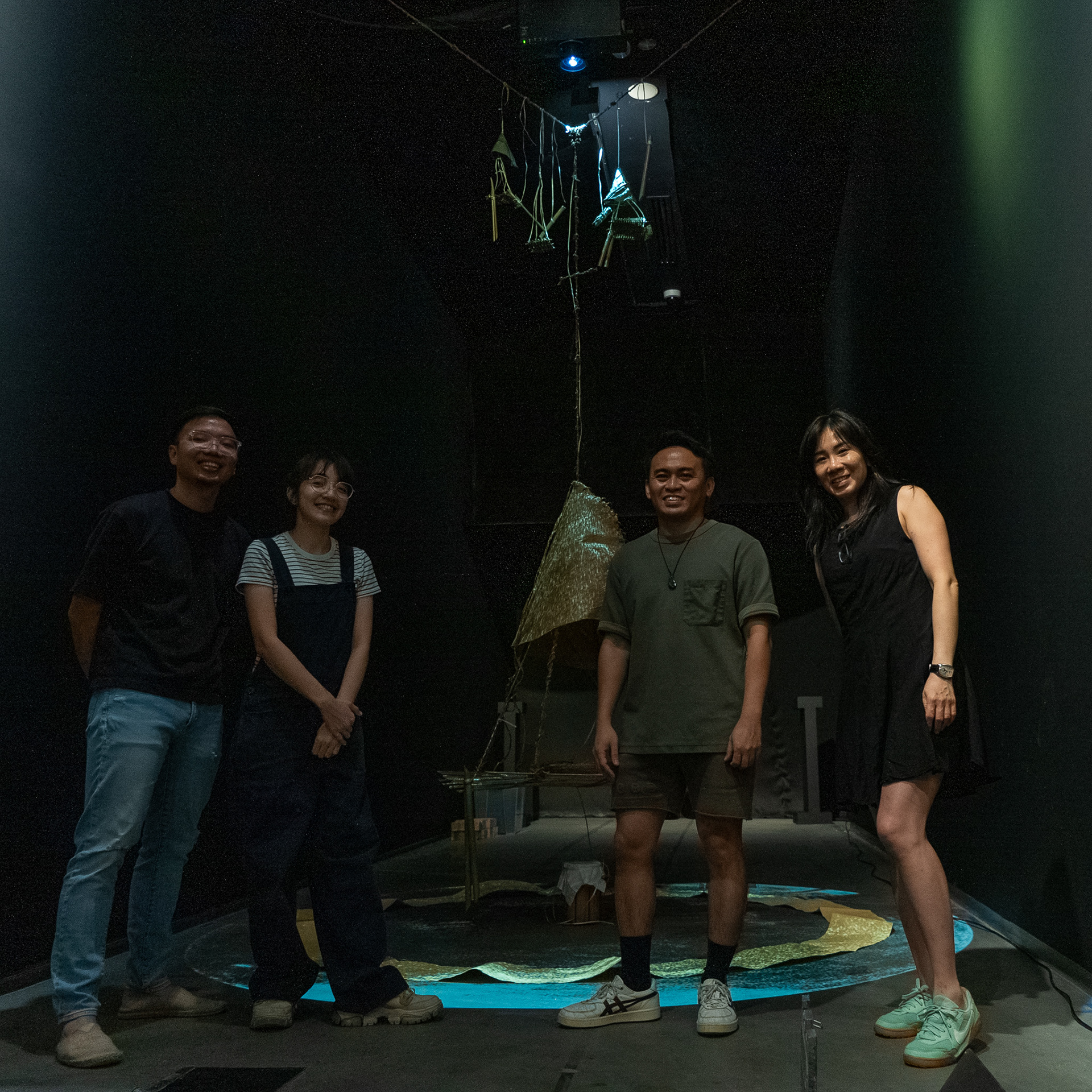
The "Circle Between Realms" Team:
Hong Hu & Adzlynn (Studio 1914), Dr Kendy Mitot, Joey Lee
References
① Mitot, K. (2023). “Budaya, Tanah, Ritual”. Svara #12, Journal SVARA. ISSN: 2716-5426-26841. (16-18)
② Mitot, K., & Lee, C. K. (2023). “Transformation Of “Adat Dayung Borih” Bidayuh Bau Myth into Animation Characters as Storytelling Medium” The International Symposium RENTASIA 2023; Malay Art and Culture Across Borders. Malaysia: College of Creative Arts Creative Media & Technology Hub, eISBN: 978-967-26841-5-2. 2023 (185).
③ Mitot. K. (2020). PhD Thesis on Myths, Symbols, and Rituals in the Bidayuh Traditional Arts at Bau, Sarawak.
④ Mitot. K. (2020). Before it runs Dry: A Stream of Ancient Beliefs. In Tan, D. M. (Eds.), Plates, Vol.3: Water. Kuala Lumpur: Wander and Wonder Creative.
⑤ Mitot, K. (2019). Rasang and the Spirit World: Rituals, Symbols and Initiation in the Life of a Bidayuh Dayung Borih at Bau Sarawak. O For Other; Malaysia Design Archive, Visual Art Program, Cultural Centre, University of Malaya.
⑥ Mitot, K., & Mahamood, M. (2019). Symbols and Rituals in The Bidayuh Traditional Arts at Bau, Sarawak. Sri Lanka: SocialConf 2019 Proceedings Journal.
⑦ Mitot, K., & Mahamood, M. (2019). Bidayuh Ritual Objects: An Appreciation and Re-Contextualization of Form and Content into Contemporary Art. Pulau Pinang, Malaysia: Penerbit USM.
⑧ Mitot, K., Kuan, V., & Sanusi, K. (2016). Sarawak Culture: A study on the cosmic influence on the bidayuh traditional woodcarving (‘Rasang’). Advanced Science Letters, USA: American Scientific Publishers 22(5), 1156–1159.
Press
① The Star, Dec '25: 'Ilham Art Show 2025' reflects Malaysia’s contemporary art energy and diversity
② The Rakyat Post, Nov '25: ILHAM Art Show 2025 Brings Malaysia’s Contemporary Art Scene to Life
Acknowledgements
Many thanks to
Rahel Joseph, Director of ILHAM Gallery
Azzad Daih, Chitoo, & Syaza Ramli
Rahel Joseph, Director of ILHAM Gallery
Azzad Daih, Chitoo, & Syaza Ramli
Images courtesy of Dr Kendy & Studio 1914
© All Rights Reserved. Dr Kendy x Studio 1914 x Joey Lee. 2025